You’ve likely seen campaigns crash and burn while others exceed every expectation. Uncovering the “why” behind those outcomes is at the core of performance marketing.
This is because it operates on a foundation of measurable, trackable results, where advertisers only pay for specific user actions, such as clicks, leads, or sales.
Some of the models that come under this are cost per mille (CPM), cost per click (CPC), cost per lead (CPL), and cost per action (CPA). These models help you figure out what you are paying for. Be it visibility, clicks, or actual results.
Among these models, cost per action stands out as the most outcome-driven and reliable. But how?
Whether you’re evaluating CPA for the first time or looking to optimise existing campaigns, this guide covers both fundamentals and operational strategies.
What is the Cost Per Action Model?
Cost per action is a performance-based payment model where partners are rewarded only when they deliver a predefined action.
Here is how it works: Before a campaign is launched, advertisers decide on the action that they want the users to take as per their business’s requirements. This could be completing a purchase, signing up for an account, downloading an app, or submitting a lead form.
Then they set a price that must be paid to the affiliate as the action is completed.
When an affiliate or partner promotes the campaign and successfully drives a user to complete that action, they earn the predetermined payout. The key is that payment only happens when the desired result is verified.
For example, a fintech company can set a CPA of $50 for every new user who completes account registration and verification. An affiliate promotes the app through their blog, and when a reader signs up and verifies their account, the affiliate earns $50. If 100 users complete this action, the company must pay $5,000, but only for the 100 registrations that have been confirmed
As marketing teams strive for higher ROI and better budget control, the cost per action model becomes the ideal approach across digital advertising channels, including search, social media ads, and affiliate campaigns.
This makes it easier to measure ROI, optimise campaigns on the basis of actual performance, and reward affiliates for driving valuable user actions.
Advertisers or businesses pre-decide the action that they expect the user to take as they plan the goals for their campaigns.
Different Types of Actions Under the Model
The beauty of CPA is its flexibility. Businesses and advertisers decide on the actions that they aim to set for their campaign in accordance with their requirements.
Some of these actions include –
- Lead Generation – Acquiring user details through forms, sign-ups, newsletters, and demo requests
- Sales and Purchase – Completing an online transaction or making a purchase
- App Install – Downloading and opening the mobile application
- Registration or Creating Accounts – Creating a new account on the platform
- In-Game Events – Reaching specific milestones, completing levels, or making purchases within the game
- Referral Conversions – Successfully inviting new users or merchants to join the platform.
These actions are chosen because they are measurable, trackable, and they tie the campaigns’ success to tangible outcomes. By defining CPA actions, businesses can ensure that every payout is made because of valuable outcomes.
Why is Cost Per Action Important?
When businesses think of growth, cost per action is the model that promises verified, high-intent actions rather than surface-level engagement.
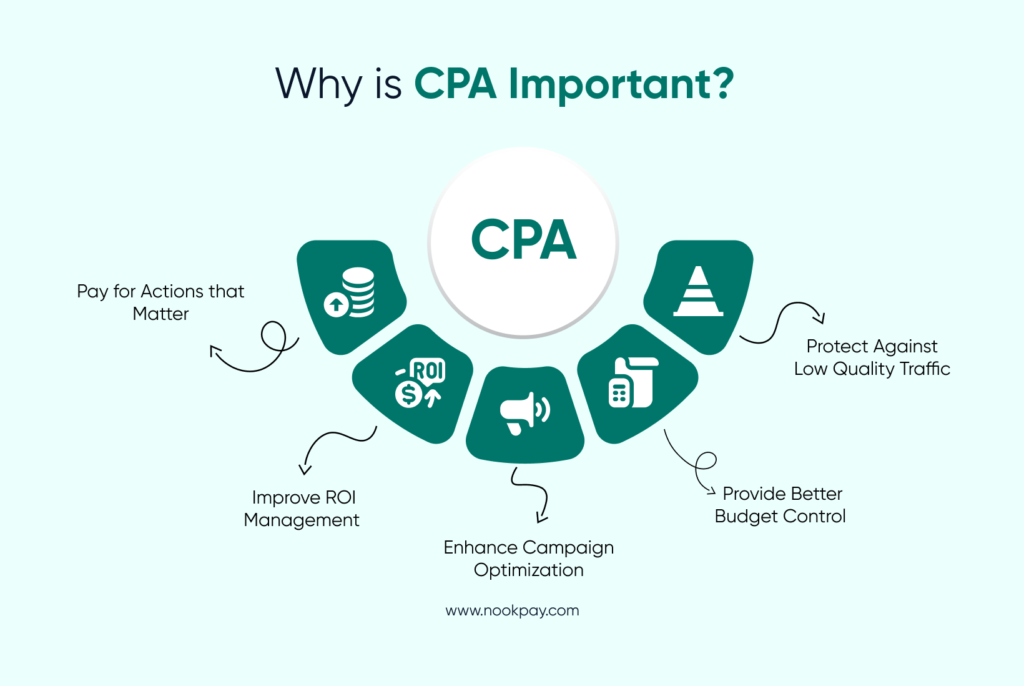
Here’s why this model is crucial –
- Connect Cost to Conversion – As the name of the model itself suggests, you only pay for actions that matter to your business and ensure a specific profitable outcome for them.
- Improve ROI Management – By comparing the ROI to the value of each action, you can determine if your campaigns are profitable. As you invest in campaigns by affiliates that assure more beneficial results, you will naturally get a better return on your investment.
- Enhance Campaign Optimisation -As the outcomes and performance of your campaigns can be easily measured with the help of CPA metrics, it will also become easier for marketers to analyse which campaigns require improvement. This is where A/B testing becomes crucial.
- Provide Better Budget Control -Investing money in campaigns that are performing well after optimising them clearly helps in maintaining the budget. By figuring this out, you can allocate the budget to the appropriate campaign and affiliates. This will also help you avoid wasting any spend on affiliates that do not provide any outcomes.
- Protect Against Low-Quality Traffic -Prioritising campaigns that deliver better results, where the affiliates bring users who actually take action, protects you from users who show interest but don’t take any action at all.
All in all, with the help of the cost per action model, you can pay for actions that matter, draw comparisons between campaigns and improve them accordingly, and pay only to those partners that bring you quality traffic, which also saves you money.
For example, a fintech app may realise Partner A drives 100 high-intent registrations per $5,000 spend, while Partner B drives 500 clicks but only 10 registrations. And so, allocating more budget to Partner A will increase ROI.
It is through several market and campaign-specific factors that the cost for a given action is set.
Factors that Influence Cost Per Action Pricing
While CPA helps businesses pay only for valuable outcomes, the actual price you pay per action doesn’t stay constant. The factors that influence it are as follows –
Market and Competition
Different industries have different CPAs in accordance with the customer’s buying behaviour. According to Flipkart Commerce Cloud, high-ticket sectors like finance or SaaS often have a higher CPA than retail or FMCG.
Additionally, the platform where the ad is displayed also plays a major role here. According to WordSream, the average cost per action for Google search ads is $51.50, while it is $47.81 for display.
Competition for keywords and ad space within the sector can be another factor that impacts the cost per action pricing. The higher the competition, the higher the pricing. It is especially during peak periods like those of festivals and holidays that this competition rises.
Campaign Elements
Campaign elements like audience targeting and action type also play a major role in determining the pricing of a CPA campaign. The specificity and quality of the target audience create an impact on your spending of the same.
Reaching a highly engaging audience reduces the CPA, which is ideally the aim of every business. Low CPA with quality users leads to better ROI. This is a win-win situation for both the business as well as affiliates.
Channel and Action
Every marketing channel has its own intent for the user, which directly impacts the pricing. Paid channels have higher intent and hence, have higher pricing.
The type of the selected action, be it installation, registration, purchase, deposit, etc., influences the final cost. Actions that require more commitment from the user naturally demand a higher cost per action.
Asking for an app install is easier than asking for a purchase, which is why purchase-based CPAs are typically higher than install-based CPAs.
Common Challenges in Cost Per Action Campaigns
While the model offers significant advantages, there are several operational challenges that both advertisers and affiliate managers must address as they run their campaigns at scale.
- Maintaining High Conversion Rate -As CPA campaigns emphasise consistent conversions, irrelevant and unqualified traffic can reduce profitability, even if the spending is high.
For example, a campaign generating 1,000 sign-ups might look successful, but only 50 became active users. The result? You’ve paid for 1,000 registrations, but only 5% delivered real business value. - Fraud and Invalid Traffic – Fake sign-ups and bot activities are highly common and can waste budgets. Key statistics claim that 17% of affiliate traffic is fraudulent in 2025, costing an estimated $3.4 billion. This is why fraud prevention is essential for sustainable CPA campaign performance.
- Tracking and Attribution Issues – Inaccurate tracking, cross-device user journeys, or misattributed actions can make it difficult to evaluate affiliate performance and optimise campaigns effectively.
- Operational Challenges – Tasks like managing multiple affiliates, monitoring performance, and ensuring accurate reporting can become complex without efficient tools and automation.
If you work with 50+ affiliates across different channels, manually coordinating performance data, verifying conversions, and calculating payouts becomes complicated. - Manual Payout Delays – Manually verifying actions and payouts slows down operations and leaves room for errors, which can also affect relations with the affiliates.
As affiliates wait for weeks for their payouts or receive wrong payments, they lose motivation and shift to competing programs that are more reliable.
Best Practices for Running Effective CPA Campaigns
For those who actually run a business’s campaigns, following a set of practices can help ensure their campaigns deliver high-quality results and maximise ROI.
Continuously Optimise Campaigns
Test different creatives, channels, and audience segments through A/B testing to determine which tactic yields the highest ROI. Additionally, you can also adjust action types and reward structures with the help of payout platforms to ensure that business priorities and affiliate focus are aligned.
Maintain Transparent Affiliate Communication
Clearly define your expected actions, payout criteria, and quality standards beforehand. It is also important to share performance insights regularly to help affiliates improve and stay aligned with campaign goals.
Protection Against Fraud and Low-Quality Conversion
Use tools and mechanisms to detect and filter out invalid or suspicious activity. Reward affiliates who bring verified traffic; this further ensures that every payout reflects genuine results.
Ensure Timely and Reliable Payouts
Automated payout platforms handle verification, commission calculation, and payment processing without any manual intervention, and ensure affiliates are paid reliably and on schedule. This operational efficiency through tools like NookPay keeps affiliates motivated and programs scalable.
Final Thoughts
Automated or well-structured performance-based payouts help maintain trust and encourage consistent high-quality conversions. Incentivise affiliates or partners who bring high-intent traffic that can convert, instead of a high volume of traffic, which will ensure a better ROI.
When advertisers combine these best practices with efficient operational processes, they create an environment that rewards quality, strengthens trust, and drives predictable and sustainable growth.
Help Centre
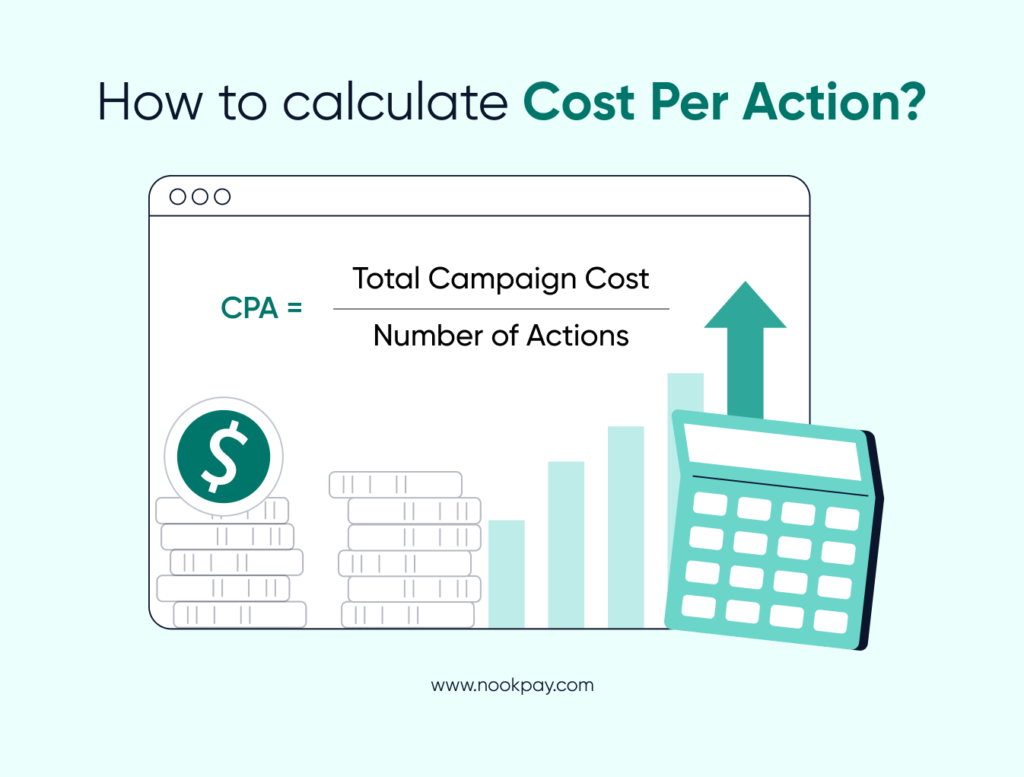
How is cost per action calculated?
CPA is calculated by dividing the total cost of an advertising campaign by the total number of desired actions generated by that campaign.
A lower CPA generally leads to higher profits, as the cost to acquire a customer is reduced.
Is cost per action the same as cost per acquisition?
The terms are often used interchangeably, but there can be a slight distinction. Cost Per Action can refer to any specified action. For example, registration, a download, a sign-up, etc.
Cost Per Acquisition, on the other hand, refers specifically to the cost of acquiring a new, paying customer.
Why does the cost per action get high?
Cost per action can be high due to multiple factors. Some of them being –
Low-quality traffic
High market competition
Slow operational process
Attribution issues
High commitment actions
Can CPA marketing be applied across all platforms?
CPA is a versatile model that can be used across multiple channels, including Google and social media platforms like Instagram and Facebook. The key requirement is to have reliable conversion tracking in place so you can accurately measure and verify when actions occur. Platforms with accurate attribution capabilities and clear conversion paths tend to work best for CPA campaigns.