The usual concepts invoked in reference to affiliate marketing are usually traffic, conversions or partnerships. If we go a little further, it may come to envelope coupons, influencers and so on.
However, none of these aspects are as much the lifeblood of the medium as is the payout model selected.
Whether you scale, acquire users or only produce a drain on resources, it is the affiliate marketing payout model which decides financial outcomes. The return on investment or ROI is a measure that relies completely on the balance between the inflow (sale, impressions, lead generation, etc.) and the outflow (commission in the form of CPA or revenue sharing).
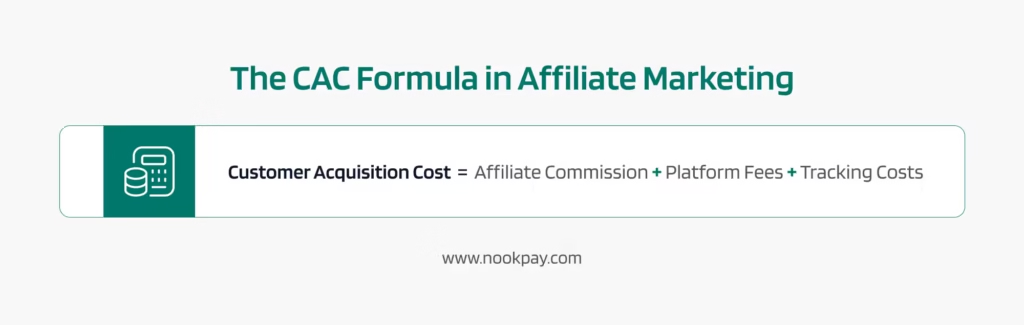
Therefore, it is crucial to examine unit economics — with respect to variables like cash flow — and profitability, — as visible through CAC and LTV — that can be uncovered through each affiliate marketing commission structure.
That’s exactly what we’re going to be covering in this article.
Affiliate Payout Models Directly Impact Customer Acquisition Cost
Think of it like this: affiliate payouts are essentially variable acquisition costs for any given business, whether it is influencer marketing or gaming promotions.

The primary affiliate marketing payout model types are as follows:
- Cost per action, where affiliates are rewarded for predefined, relevant actions such as a sale, lead generation or increase in brand visibility.
- Revenue sharing, where affiliates are provided a percentage of sale or subscription as commission.
- Hybrid commissions, which provide the best of both payout models. Publishers and influencers can be rewarded with a CPA in addition to a share in the overall revenue generated through their actions.
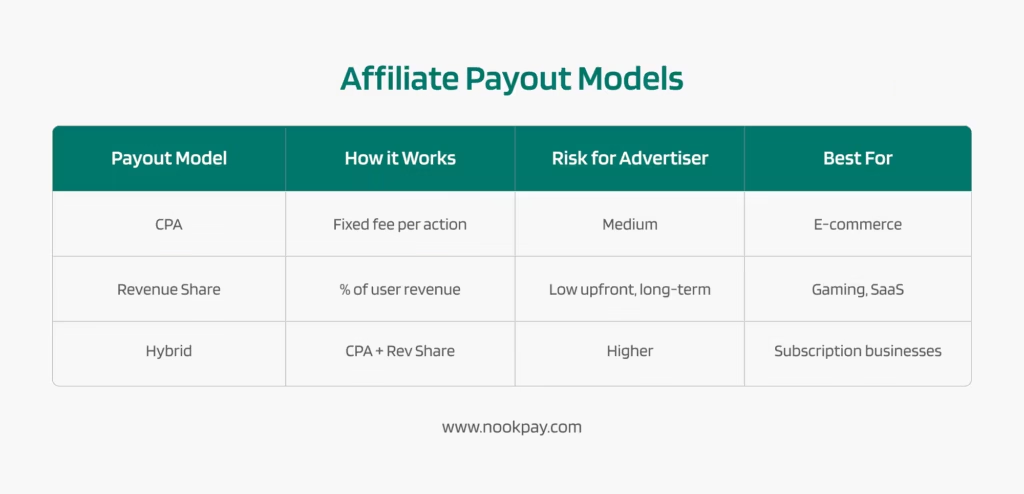
When these types of expenses aren’t structured well, it causes bloat within the entire marketing spend, and may even eat up a significant amount of the overall allocated budget. In fact, when campaigns lack ceilings determined by goals, CAC or some other variable, there is a tendency to go overboard.
Consider the fact that CPA is a fixed fee, which is spent every time say, a sign up, install, download or a sale is made. If that action is not economically significant towards your bottom line, you’re sure to be in trouble.
When you take the same argument further into revenue share, it increases uncertainty despite being better aligned with long-term value.
The hybrid affiliate marketing payout model, many believe, balances both expectations in the best manner. However, if your margins are thin, it is sure to stress them even further.
Determining which format is best suited for your business settles the first part of the puzzle.
The Relationship Between Payout Models and Customer Lifetime Value
Next, there is a need to investigate the comprehensive value provided by users who are acquired as a result of running affiliate marketing or influencer campaigns.
For instance, when we’re talking about gaming promotions or subscription formats in the B2C space, there is an ongoing value addition. In this case, using a revenue share model is more suitable because users are generating ongoing revenue.
However, when we consider an e-commerce platform, the ‘action’ that is driven through any affiliate marketing payout model is going to be a sale. This is a one-time event. Hence, CPA is better suited.
This brings us to two conclusions:
- Where the lifetime value is expected to be higher (and spread out across a significant time), the revenue share model is better suited towards scaling affiliate ecosystems profitably.
- When the value provided is limited, fixed or uncertain, the use of CPA can help in reducing financial risk experienced by the given advertiser.
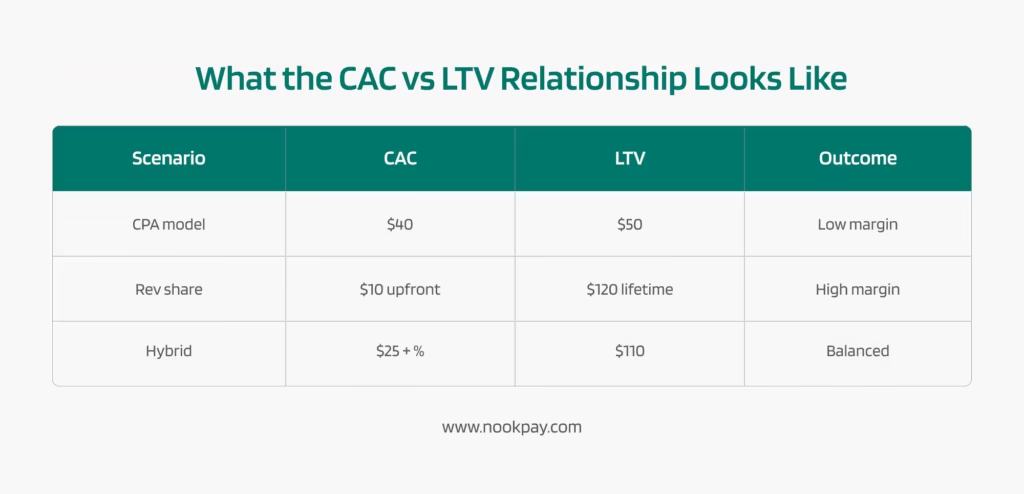
Cash Flow and Working Capital Implications
The deal with affiliate commissions is that they happen at regular intervals. Often, these time periods are fixed through affiliate agreements between the ad network or advertiser and the publisher.
While commissions are performance-based, they still represent real liabilities that must be managed alongside operational expenses, inventory costs and marketing budgets.
Affiliate payouts typically follow structured cycles such as Net-30 or Net-45 agreements, meaning publishers are compensated 30 to 45 days after the tracked action occurs. Yet, this is sureshot. Revenue from those same actions may not always be realized immediately.
Consider:
- Refunds,
- Subscription cancellations, and,
- Chargebacks
To manage this uncertainty, many affiliate programs introduce validation windows of 30–60 days before confirming commissions. This means: businesses filter fraudulent activity and account for product returns before payments are released.
When the affiliate marketing payout model’s timelines are not aligned with revenue realization, companies may find themselves paying commissions before the revenue is fully secured. For high-growth businesses, this mismatch can create pressure on working capital and limit the ability to reinvest in growth initiatives.
To address this, organizations often implement payout thresholds, staggered payment schedules or rolling commission approvals.
Margin Compression from Poorly Designed Commission Structures
Standardized payouts that are given to affiliates or influencers during campaigns, without an eye on the actual product value or customer stickiness can lead to margin compression. You’re rewarding individual acts while the revenue secured through affiliate marketing may need to be consistent or effective beyond the short term.
Flat commissions or CPA models, without adequate fraud checks or quality filters, push the cost of acquisition up (as compared to incoming revenue).
Another consideration is new versus returning customers. Both conversions are secured with different levels of ease and effort. The returning customers may have made the purchase in any case — and that’s something your affiliate marketing payout model needs to account for.
To manage these risks, many marketplaces and digital platforms introduce tiered commission structures. Here’s how it applies:
- Higher payouts are reserved for first-time customers, while,
- Repeat purchases carry lower commissions.
The Role of Automation in Managing Affiliate Payout Economics
As programs grow, managing them becomes more complex. Manual tracking and payment reconciliation can quickly lead to accounting errors, delayed payouts and compliance problems.
The good news is that modern affiliate payment infrastructure automation is now a norm.
So, what exactly gets done on its own, here?
- The calculation of commissions across different affiliate marketing payout models
- The processing of payments across currencies and geographies
- Maintenance of transparent records for both advertisers and publishers
Automation also helps businesses manage tax requirements, fraud detection and reporting across large partner ecosystems that may include thousands of affiliates worldwide.
Final Thoughts
Choosing the right affiliate marketing payout model requires balancing customer acquisition costs, lifetime value expectations, operational cash flow and partner incentives.
When these variables are aligned, affiliate programs can scale sustainably without putting pressure on margins or working capital.
Help Centre
What is payout in affiliate marketing?
A payout in affiliate marketing is the commission or compensation paid to an affiliate for driving a specific action, such as a sale, lead, install or subscription.
How do you get paid from affiliate marketing?
Affiliates get paid when users complete tracked actions through their referral links or coupon codes, with commissions calculated based on the program’s payout model such as CPA, revenue share, or hybrid structures.
Who pays you in affiliate marketing?
Affiliate payouts are typically paid by the advertiser or merchant, often through an affiliate network or partner performance platform that manages tracking and commission distribution. They can also make use of a platform like Nookpay to process invoicing and payments, no matter which affiliate marketing payout model is being used.
What payment methods are used to process affiliate payouts?
Common affiliate payout methods include bank transfers, PayPal, digital wallets, wire transfers, and specialized payout platforms like Nookpay that support partner payments.